- 212 views
- 14 December 2023
Research: In H2 2023, over a third of new developments in Dubai are running behind schedule
Tranio’s analysts have examined data provided by the Dubai Land Department (DLD) on the status of construction projects in the emirate. According to the department’s reports, 35% of all current projects were overdue at the start of H2 2023. The median handover delay for all new buildings is 6 months, and for large projects the delay is more significant, averaging at a delay of around 2.5 years.
In the longer term, the risk of missed deadlines on major developments has led to a gradual reduction in the average size of projects in Dubai. Developers are more cautious in allocating construction volumes across phases, taking into account the cyclical nature of demand and potential crisis scenarios in global markets.
The more metres, the slower the pace?
The study included data on the state committee’s inspection of newly constructed buildings in Dubai over the past 20 years (June 2003 to June 2023), which is available to the public on the DLD portal. The Dubai authorities have not only published the final results, but also reports on intermediate stages, allowing for thorough monitoring of the construction industry. This efficient system means that subsequently, construction sites in Dubai are less likely to miss deadlines: 65% of all projects are completed on time.
For nearly half of the delayed projects, the deadline has only been slightly exceeded, by less than 6 months from the expected commissioning date.
The median handover delay was 6 months, while the average was 15 months. The difference is due to the fact that the projects with a delay of more than 6 months represent a larger volume in terms of square metres. Regarding the total area of these projects, 20% is overdue by about 2.5 years and 41% is overdue by 10 years or more.
The emergence of such projects is due to court proceedings, which have resulted in some of the already suspended construction projects being added to the DLD database and tagged with the «under cancellation» status. At present, there are only three projects that have been delayed for 10 years or more, but they account for a significant area due to the large scale of the construction.
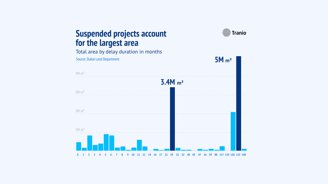
However, the figures show that the size of the project is not statistically related to extended delays. Developers who are leaders in terms of commissioning volume and maximum project area do not have higher proportions of «overdue» metres or longer handover delays compared to the emirate average.
Dubai flavour: the launch and cancellation of big construction projects
According to DLD, a total of 953 residential projects have been launched in the emirate over the past 20 years, representing approximately 64% of all projects in the database. A further 27% (408 projects) are currently under construction, while 9% (129 projects) have been cancelled or are in the process of currently undergoing cancellation.
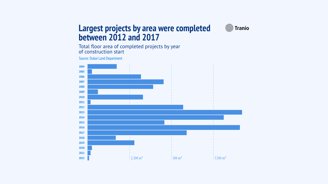
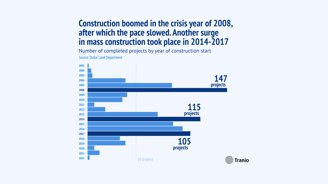
Historically, Dubai’s major developers have been able to meet their housing delivery targets even during periods of global financial turmoil. Whilst numerous projects were initiated during Dubai’s primary market boom in 2008, many of which were eventually completed, fewer projects were launched in the following years. The next phase of construction growth took place between 2014 and 2017.
Looking at completed, active, and cancelled projects in terms of floor area, the largest share is accounted for by cancelled construction projects: 184.5 million sq. metres (or 64% of the total).
It can be assumed that this gap is due to the fact that Dubai developers have often abandoned the grandiose construction projects for which the emirate is famous. However, some of these mega-projects are now being restarted with the participation of new investors. For example, the Dubai Creek Harbour development project was recently announced as due to restart construction in 2024, with a new master plan already in place.
Compared to the emirate’s ambitious plans, the actual volume of construction that has actually been completed is not quite as large as one might imagine. Over the past 20 years, some 62.7 million square metres of residential space has been commissioned in Dubai, with a further 38.4 million square metres currently under construction. Contrary to a common stereotype among investors, the total number of new buildings in Dubai has been decreasing rather than increasing over the past 5 years.
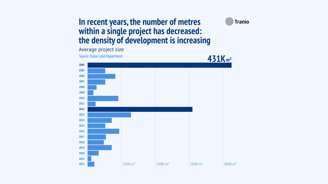
The highest number of construction projects (151) was launched in 2008, and the next peak came in 2017, when 135 projects were launched. It is however worth noting that in recent years, there has been a trend towards a reduction in the number of metres within a single project: Dubai is moving away from large-scale construction and instead towards a phased planning of land development.
Anti-rating of Dubai developers: who has delayed the most metres?
According to DLD reports, around 50 developers in Dubai failed to meet the handover deadlines. Two major companies, EMAAR and Nakheel holdings, accounted for 44% and 35% respectively of the total area which was not delivered on time. The projects of the third-worst performer, Azizi Holding, accounted for only 2% of the delayed metres.
Over the past 20 years, EMAAR and Nakheel have missed deadlines to build a combined 12.9 million sq. metres of residential space. All other developers in Dubai have delayed the construction of a further 3.6 million sq. metres.
For a more objective assessment, it is important to consider the scale of the implemented projects. Emaar Holding has a correlation of 24% between «overdue» metres and the area of commissioned housing, while Nakheel has a correlation of 54%. Of the 15 developers who have delayed the delivery of the largest areas of residential space in Dubai (more than 120,000 sq. metres each), several others have a high correlation of «overdue» metres to delivered ones: Azizi at 72%, Mag Group at 68%, and Omniyat Properties and Dubai South Freezone at 61% each.
Among the 15 participants of the anti-rating, there are also companies whose proportion of «overdue» metres in their project portfolio surpasses that of completed ones. Continental Investments have 5 times more «overdue» metres, while Mazaya Holding has 1.2 times more. Moreover, three developers from the top 15 who are currently lagging behind do not include «completed» metres in their records at all, only «overdue» ones. These three developers are Jumeirah Group, Alhamah Shamal Real Estate Development, and Gulf Developers. It is worth highlighting that none of the mentioned companies have an average handover delay that exceeds 60 months.
This begs the question: Can we really rely on developers who allow handover delays?
When evaluating a developer’s portfolio, one should not solely rely on delay statistics. It’s possible that the developer inherited delayed projects from colleagues who were unable to complete them. For instance, Emaar Holding recently committed to completing several problematic properties in Dubai. However, the developer’s overall work plan is still affected by additional obligations.
This year, several new Emaar projects have started with a construction period longer than the company’s typical 3-4 years. This is the developer’s method of protecting against the risk of delays.
Dubai 2025: How many metres will be constructed?
The planned volume of housing commissioning in Dubai piques the interests of investors who invest in new buildings amid rising property prices and the government’s development strategy, which aims to attract hundreds of thousands of foreign specialists to the UAE. Over the past few decades, Dubai has demonstrated a prosperous track record of attracting expats, who now constitute around 90% of the emirate’s population. Foreign demand for rental properties and the flourishing tourism industry are drawing increasing amounts of foreign investment into Dubai’s real estate market.
Notably, wealthy individuals from abroad — in addition to the working and middle classes — are relocating to the region. According to Henley & Partners’ predictions, approximately 4,500 high net worth individuals (those with assets exceeding 1 million US dollars) may settle in Dubai by the end of 2023. Dubai developers are accommodating new residents as they expand their construction efforts. This year’s housing sector’s plan is to commission roughly 5.2 million sq. metres (with 1.6 million having already been commissioned in H1 2023), and this figure may more than double by 2025.
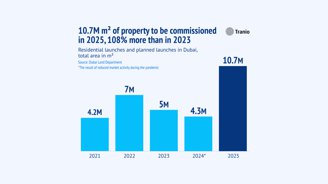
If all of Dubai’s developers meet the construction deadlines outlined by their current projects, this will provide more than 10.7 million sq. metres of new residential space available in the emirate; scheduled for completion by the end of 2025.
The unprecedented amount of residential real estate available in 2025 is the result of Dubai’s effective strategy to attract a skilled workforce and cultivate a favourable business climate. Many neighbourhoods are undergoing long-term development, and the continuing trend of population growth is enabling developers to undertake large-scale construction projects.
Significant changes in the market are evident and progress towards the 2025 goals is underway. Dubai’s real estate market continues to evolve and the UAE’s immigration policy is attracting many buyers. While the housing commissioning plan reflects global trends, it will not help you choose a specific area. We recommend that you research your options thoroughly before deciding where to invest in property.
Dubai districts’ construction deadline heat map
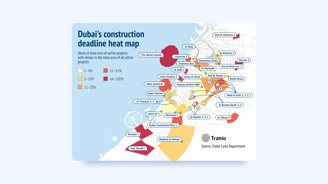
The majority of projects that are falling behind schedule are situated in Dubai’s developing areas, rather than in already established locations. These encompass the inner lands of the Emirate, where barren desert regions are being transformed with greenery, landscaping, and reasonably priced housing (e.g., Warsan 2), or where fresh industrial sectors are being established (e.g., Saih Shuaib 1).
Due to the pandemic’s impact in 2020-2021, certain new tourist areas have experienced construction delays. This is particularly significant for the artificial islands known as ‘The World Islands’; initially announced in 2003, then delayed first in 2008, second during the pandemic. At present, most of the construction work in this area has already resumed and is attracting notable investor interest. The developments planned for ‘The World Islands’ are set to feature resort apartments, leisure facilities, and high-end hotels.
- Authors
Elena Skrebkova, Diana Imamgaiazova