Driving License in Turkey

Foreign nationals may generally drive in Turkey using a valid foreign licence for up to six months after entry, subject to the applicable document and translation requirements. An international driving permit accompanies the national licence; it does not extend this six-month period. Longer-term residents need to follow the Turkish licence procedure.
Foreign driving licenses in Turkey
Drivers with foreign licenses can drive vehicles in Turkey. The country’s authorities recognise foreign driving permits under the Vienna Convention on Road Traffic, which has been signed by 84 countries to date. Signatories to this agreement accept driving licenses from residents of other participating countries.
Difficulties may arise if a driver has an older license format where not all information is duplicated in Latin script. In Turkey’s tourist regions, car rental companies usually overlook this, but traffic police have the right to request documents with complete transliteration.
Foreigners who have experience renting cars in Turkey during holidays should note that in non-tourist regions, car rental and insurance companies may request an international driving permit to finalise contracts. To avoid having to contact the consulate for translations or paying local intermediaries to process international licenses during your trip to Turkey, you can order this document in advance at home.
What is an international driving license?
An international driving permit confirms driving rights outside the country where the driver passed the state driving exam and received their license. Essentially, it’s a translation of the national driving license into the main languages of international communication. It must be presented together with the original.
Please note that if you lose your original driving license, the international permit becomes invalid as it is not a standalone document.
The application for an international driving license must include:
- A valid national driving licence.
- The identity documents, photographs and payment required by the authorised issuer.
For an in-person Turing application by a foreign national, the published list includes the original licence, two photographs and a translation certified by a consulate or embassy. Requirements in other issuing countries can differ.
Note: A medical certificate is not required for IDP, but may be needed for obtaining a Turkish driving license. Translation of the driving license into Turkish may be required for other procedures.
An IDP’s validity depends on the convention and issuing authority. Turing’s international permit is valid for one year and must be used with the national licence; it is not valid for driving in the country where it was issued.
Driving license in Turkey for car rentals
If you plan to stay in Turkey for less than 180 days and rent a car during your holiday in resort areas, a foreign driving license will be sufficient. However, to avoid problems with insurance companies, it’s still better to have an international driving permit.
In the worst-case scenario, a local rental office might provide a car with insurance included in the package without paying attention to the inappropriate license type, which could cause headaches for the driver in the event of an insurance claim. If you haven’t translated your license in advance, this service can be ordered in Turkey from local operators — though it will cost more.
Turing offers an international driving permit for use together with a valid national licence. Its published fee is TRY 7,800 for first issue and TRY 4,424.85 for renewal, with an additional TRY 240 for an online application. The permit is valid for one year and is not valid in Turkey, where it is issued.
Peculiarities of Turkish traffic rules
Many foreigners familiar with Turkish roads note that local drivers aren’t particularly attentive to following the rules: they exceed speed limits, don’t signal when turning, honk their horns, and park wherever it’s convenient for them. Pedestrians may also cross the road in unauthorised places, but most traffic accidents in Turkey are caused by drivers. According to official data, in 2021, drivers were responsible for 87% of accidents in the country, while pedestrians accounted for only 8%.
Accidents involving injuries are more common in cities, which is why Turkey has a low speed limit for populated areas — 50 km/h. Outside cities, you can accelerate up to 90 km/h, and on highways — up to 130 or 140 km/h.
For private-car drivers, the administrative alcohol limit is 0.50‰; for drivers of other vehicles it is 0.20‰. Additional criminal consequences can apply, including in cases involving an accident.
On Turkish roads, seat belts are mandatory for the driver and all passengers, and children weighing up to 36 kg must be in a child seat in the back seat.
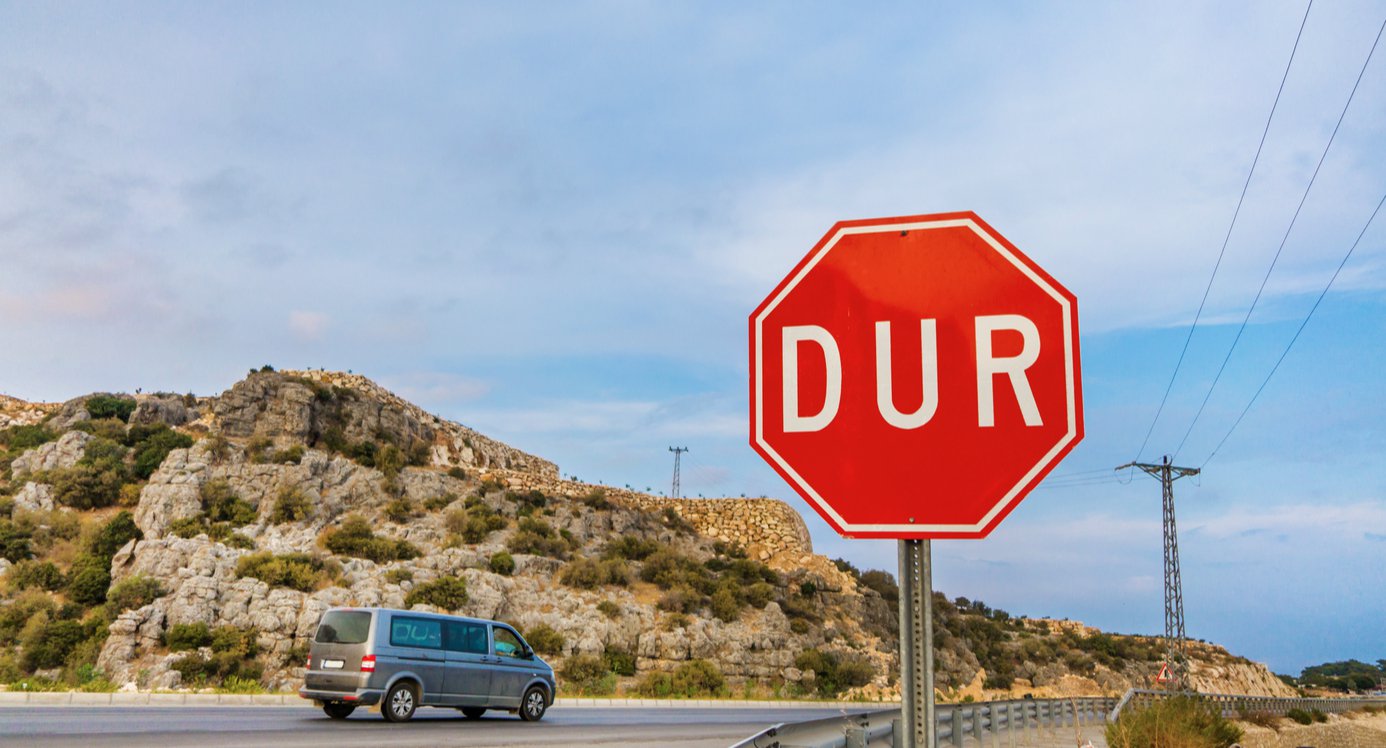
Turkish road signs are usually designed graphically according to global standards, and many text indicators are translated into English. However, there are some exceptions: for example, instead of the familiar «STOP», Turkey uses the sign «DUR».
Fines for traffic violations
Turkey’s 2026 traffic penalties are set out in the official guide updated on 27 February. The amounts below are before the prompt-payment discount; repeat offences and other circumstances can lead to additional penalties. TÜİK publishes separate road-accident statistics.
| Violation — selected 2026 penalties | TRY / additional measure |
|---|---|
| Speeding in a built-up area by 6–10 km/h | 2,000 |
| Speeding outside a built-up area by 11–15 km/h | 2,000 |
| Drink-driving, first offence | 25,000; licence suspended for 6 months |
| Drink-driving, second offence within five years | 50,000; 2-year suspension |
| Drink-driving, third or subsequent offence within five years | 150,000; 5-year suspension |
| Refusing the required alcohol/drug test | 150,000; 5-year suspension |
| Driving under drugs | 150,000; licence cancelled |
| Not wearing a seat belt | 2,500 |
| No compulsory insurance | 1,246 |
| No required vehicle inspection, initial offence | 2,719 |
| Driving without ever holding a licence | 40,000 |
| Driving with an expired licence | 4,712 |
| Running a red light, first offence | 5,000 |
| Stopping where prohibited by a sign | 1,246 |
Current fines are quite substantial, and late payments incur penalties. Non-payment of fines can be grounds for detention at the border when leaving the country: in spring 2022, such measures were introduced for freight carriers.
Paying fines in Turkey
A traffic administrative fine paid within one month of notification qualifies for a 25% discount. Payment can be made through the authorised tax-office, bank and digital channels.
You can pay the fine without additional charges within the first 30 days; after that, late fees of 5% per month are added.
Tourists can pay traffic fines through GIB’s digital services and authorised payment institutions, subject to the identification and vehicle details required by the chosen service.
Obtaining a Turkish driving license
Foreign nationals may use a valid foreign driving licence in Turkey for up to six months after entry. Those staying longer need to follow the Turkish licence procedure; an international driving permit does not extend this period. Separate rules apply to Turkish citizens using foreign licences.
What happens if you don’t change your driving license
What consequences might violators face if they drive in Turkey with a foreign license beyond the permitted period?
- First, a substantial fine if expired licenses are discovered during document checks or when involved in an accident.
- Second, in case of an accident, drivers with expired licenses won’t be eligible for insurance payouts either for repairing their own car or for compensating damage to other drivers.
The opportunity to avoid fines and even higher repair costs is worth preparing the rather substantial package of documents required to exchange your driving license for a Turkish one.
Licence applications are handled by NVI. Make an appointment through the NVI appointment service or by calling 199. A temporary driving document can be checked through e-Devlet.

Documents for obtaining a Turkish driver’s license
The entire process of replacing a driving license takes place in three stages: 1) initial reception, 2) applicant verification, 3) secondary reception and document exchange.
In the first stage, you need to provide only the basic package of documents to the General Directorate of Population and Citizenship Affairs:
- a copy of the ikamet card (Turkish residence permit);
- a copy of the first page of your passport;
- a copy of your driving license with a notarised translation into Turkish;
- a photograph measuring 5 by 6 cm.
Document copies must be in colour, and the applicant’s photo must meet biometric standards: front view portrait, face not obscured by hair or headwear, good image quality without glare, etc.
After the initial reception, Turkish authorities will send an official request to the traffic police to verify the authenticity of the provided documents, as well as the presence or absence of a criminal record for the applicant. Interagency verification can take from several weeks to several months.
After verification, the applicant will receive an SMS inviting them to the Nüfus office. You can also call 199 yourself and check the date of the second appointment.
At the second appointment, you will need to provide a complete package of documents:
- A copy of your education document (school certificate or university diploma) with a notarised translation into Turkish.
- A medical certificate indicating blood type and vision test results. This can be obtained at any Turkish hospital.
- Your driving license (original).
- A photograph measuring 5 by 6 cm.
- Receipt of fee payment. The 2026 card and foundation charges total TRY 2,115, plus any applicable class-specific duty. For comparison, the full first-issue category B charge is TRY 8,869.60; translation and medical costs are separate.
At this stage, your license will be taken, and the original will be sent by mail to the authority that issued the document. Your new Turkish license will be ready in 5–6 days, and during this period, you will be issued temporary driving rights.
When moving to Turkey, some people worry about having to surrender their driving license. However, upon returning to their country for permanent residence, they can retrieve it from the traffic police department.
Even if the document happens to get lost during shipping, it’s not that difficult to restore it by application. Licenses from all countries participating in the Vienna Convention on Road Traffic are valid in the same territories.
Validity depends on the licence category: category B and the other ordinary light-vehicle categories are normally valid for ten years, while C- and D-group categories are valid for five years. Medical restrictions can also affect the licence.
Obtaining a Turkey driving license from scratch
Foreigners often attend Turkish driving schools. After relocating and changing lifestyles, the need for driving skills frequently arises for those who have never driven before. And experienced drivers often come to driving courses to «relearn» — to find out about differences in traffic rules and road network peculiarities.
The most in-demand courses at Turkish driving schools are for category B. Obtaining this in Turkey is also possible from the age of 18, but first, you need to complete courses with mandatory driving hours with an instructor, lectures, and tests on traffic rules. In Turkey, there are already many driving schools where driving courses can be taken in English and other languages.
The theoretical part of the driving test in Turkey can be taken in a foreign language, and for the practical part, there’s an option to choose a car with automatic or manual transmission.
Driving schools in Turkey: features and cost of training
Driving-school costs and schedules depend on the licence category, number of lessons and school. In Istanbul, Villa Levent publishes course information on its website. Allow separately for examination, medical and licence-issue payments when budgeting for training.
Document list for obtaining a Turkish driving license from scratch
To enrol in a driving school, you need to prepare the following documents:
- a copy of your identity document and the original for verification when submitting (if the document is not in Turkish, a notarised translation is required);
- a copy of your school leaving certificate or university diploma, with a notarised translation into Turkish;
- a colour copy of your residence permit;
- 4 photographs measuring 5 by 6 cm;
- a health certificate (which can be obtained at the driving school itself, cost — around 120 lira);
- information about your place of residence in Turkey, which can be obtained online through e-Devlet (similar to government services portal);
- additionally, some driving schools request a criminal record certificate, which can also be processed through e-Devlet.
Driving school exams
The questions for the state driving license exam are posted on the website of the Turkish Ministry of Education. The first, theoretical part of the exam includes 50 questions across three categories: vehicle operation, traffic rules, and emergency medical assistance. You need to correctly answer at least 35 questions and score a total of at least 70 points.
If these tests are passed successfully, then in 2–3 weeks you can proceed to the practical exam, which follows a route practised in the school. At this stage, students demonstrate parking skills, garage entry, and overpass climbing. However, in Turkey, during the exam, there will be not only a traffic police inspector in the car but also a driving school instructor, which eliminates the risk of a subjective assessment of the student’s skills.
In 16 years of living in Istanbul, I’ve never heard of anyone «failing» a driving test in Turkey. Examiners are usually friendly, and almost all driving school students pass their exams on the first attempt.
Of course, for this to happen, you need to drive carefully, strictly following all the rules. And there’s no need to fear prejudice against foreigners or hints about «gifts» for the inspector.
After successfully passing all exams, the driving school will send a response that you can collect your certificate of completion. Then you’ll need to make an appointment at the General Directorate of Population and Citizenship Affairs to receive your license and pay the applicable issue fees. For a first category B licence in 2026, the duty, card and foundation charges total TRY 8,869.60, excluding school and examination costs.
After the application and required identity checks, the licence is delivered to the declared address by PTT. An ordinary category B licence is normally valid for ten years; other categories can have shorter validity.
We will send you a content digest not more than once a week