Turkey Visa Guide in 2026: Requirements for International Travelers

Many international travelers can visit Turkey without a visa for short-term stays. However, visa requirements vary significantly by nationality, and understanding these rules is essential for a smooth entry. This comprehensive guide covers everything you need to know about Turkish visas, residence permits, and legal stay requirements in 2025.
Whether you’re planning a brief vacation or considering long-term residence, Turkey offers various programs: from tourist residence permits to property-based residency. Let’s explore all options and requirements for international travelers in 2025.
Visa-Free Entry to Turkey: Key Rules
Many nationalities enjoy visa-free access to Turkey for tourism and short business trips, though the permitted duration varies by citizenship.
Visa Exemption for Different Nationalities
Visa requirements for Turkey depend on your citizenship and passport type. Here’s what you need to know:
US Citizens: no visa required for tourism or short-term business trips lasting up to 90 days within a 180-day period.
EU/Schengen Citizens: most EU and Schengen Area citizens can enter visa-free for up to 90 days within any 180-day period.
UK Citizens: British passport holders can stay up to 90 days within any 180-day period without a visa.
Canadian Citizens: visa-free entry for up to 90 days within a 180-day period.
Australian Citizens: must obtain an e-Visa before travel, which allows stays up to 90 days within a 180-day period.
The «90 days in 180 days» rule works as follows:
Scenario | Maximum Single Stay | Total Limit per 180 Days |
Standard visa-free entry | Up to 90 days consecutive | 90 days cumulative |
Rolling calculation | Depends on previous stays | Maximum 90 days total |
Example Calculation: If you enter on January 1 and stay 60 days, leaving March 1, you can re-enter for up to 30 more days, provided your total stay doesn’t exceed 90 days within the previous 180-day rolling window.
The 180-day period is calculated on a rolling basis, not by calendar year. Immigration authorities check daily how many days you’ve spent in Turkey over the preceding 180 days.
Passport Validity Requirements
To enter Turkey, foreign nationals must present a passport valid for at least 60 days beyond their planned stay or visa expiration date, whichever is longer.
Additional passport requirements:
- Passport must be in good physical condition.
- Sufficient blank pages for stamps (at least 2–3 pages recommended).
- Children may need their own passport depending on age and nationality.
- Expired passports are generally not accepted (some EU citizens have exceptions).
Documents You May Need at the Border
While border officers rarely request additional documents from tourists, they have the authority to ask for:
- Proof of accommodation (hotel reservation or address).
- Return/onward ticket.
- Proof of sufficient funds (cash, credit cards, bank statements).
- Travel medical insurance (not mandatory but recommended).
Overstaying your permitted duration leads to fines and potential entry bans ranging from 1 month to 5 years. Always track your days carefully.
What If You Need to Stay in Turkey Longer Than 90 Days?
If you plan to remain in Turkey beyond the visa-free period, you have two legal options. Overstaying is a serious violation with significant consequences.
Legal pathways for extended stays:
- Obtain a Residence Permit (ikamet) — applied for while in Turkey on valid entry status.
- Secure a Long-Term National Visa (Type D) — obtained from a Turkish Embassy/Consulate before traveling
After submitting a residence permit application, you can legally remain in Turkey until a decision is made, even if your visa-free days expire. You may exit and re-enter Turkey for up to 15 days during the application process.
The popular «visa run» strategy (exiting to reset the stay period) has become risky since 2023. Turkish authorities have intensified scrutiny, and frequent short exits may result in entry denial, especially if you’ve exhausted your 90-day limit.
We strongly advise against relying on visa runs as a long-term strategy. Since 2023, we’ve seen increased cases of entry refusal for travelers who repeatedly use this method. It’s far more reliable to obtain official status through a residence permit or property ownership.

Types of Long-Term Visas and Residence Permits in Turkey

Turkey offers diverse programs for long-term residence. Here are the main options based on different purposes and eligibility criteria.
Tourist Residence Permit (Short-Term Ikamet)
Travelers wanting to stay in Turkey beyond 90 consecutive days can obtain a short-term residence permit, or ikamet. This is the most common option for extended visits.
Key Features:
- Initial duration: 6 months for first-time applicants.
- Renewable every 6 months.
- Does not grant work authorisation.
- Allows multiple entries and exits.
Basic Requirements:
- Application form completed on the e-ikamet website.
- Valid passport with copies of relevant pages.
- Health insurance covering the entire permit period.
- Notarised rental agreement.
- Bank statement showing sufficient funds (approximately 1.5 times minimum wage, which is 33,156 TL or $870 in 2025).
- 4 biometric photographs.
Residence Permit Through Property Ownership (TAPU-Based)
Property ownership provides the simplest path to residence. This permit is available to buyers of real estate valued at 200,000 US dollars or more.
Advantages of Property-Based Residence:
- Long-term status (up to 5 years).
- Not subject to district quotas.
- Option for family residence permits for spouse and children.
- Stable and predictable process.
Property Requirements:
- Minimum property value: $200,000.
- Property must be registered to the applicant.
- TAPU document required (Turkish property deed).
 From 17,530,000 TRY
Completion in: 2027.IV Total of 2644 apartments
 From 12,381,000 TRY
Completion in: 2026.IV Total of 294 apartments
 From 15,848,000 TRY
Completion in: 2026.II Total of 369 apartments
 From 27,239,000 TRY
Built in 2025 Total of 544 apartments
 From 35,658,000 TRY
Completion in: 2026.IV Total of 295 apartments
 From 23,970,000 TRY
Completion in: 2026.II Total of 781 apartments
 From 14,107,000 TRY
Completion in: 2026.IV Total of 2800 apartments
 From 48,584,000 TRY
Built in 2024 Total of 1557 apartments
Only one primary owner can receive the long-term residence permit. Spouses and children are eligible for tourist or family residence permits.
Work Visa and Permit
A work visa allows official employment with a Turkish company. The employer initiates the process, making this option available only with a confirmed job offer.
The Turkish employer submits an application to the Ministry of Labor requesting a work permit for the foreign employee. After ministry approval, the applicant visits a Turkish Embassy/Consulate abroad, submits documents, and receives the work visa. Following entry to Turkey, the employee applies for a residence permit based on the employment contract.
Can you obtain a work permit while in Turkey? Yes, if you already hold a valid residence permit for at least 6 months. In this case, the employer applies to the Ministry of Labor, and the transition to a work permit occurs without leaving the country. Tourists on visa-free entry cannot convert to work status without departing first.
Essential Documents:
- Valid passport.
- Educational diploma (apostilled and translated).
- Criminal background check (apostilled).
- Medical certificate.
- Employment contract from Turkish employer.
- Proof of qualifications.
Student Visa and Residence Permit
Student residence permits are issued for the duration of studies and can be renewed twice. To renew, students must obtain a visa outside Turkey and present documentation from an institution authorized by the Ministry of National Education.
Student residence permits cover enrollment in Turkish universities, language courses, academic exchange programs, internships, and research activities.
Key Requirements:
- Acceptance letter from educational institution.
- Proof of tuition payment.
- Academic records (diploma, transcripts).
- Health insurance.
- Proof of financial means.
Family Residence Permit (Family Reunification)
Family residence permits are issued to spouses and children of Turkish citizens or foreigners holding long-term residence permits.
Eligible Recipients:
- Spouses of Turkish citizens.
- Children under 18.
- Foreign nationals married to long-term residence permit holders.
Required Documents:
- Marriage certificate (apostilled and translated).
- Birth certificates for children.
- Documents proving sponsor’s status in Turkey.
- Proof of family relationship.
Other Visa Types (Business, Guest, Transit)
Business Visa is intended for entrepreneurial activities, trade show participation, and business meetings. Residence through business establishment requires a minimum capital of 10,000 Turkish lira.
Guest Visa is issued for visiting friends and relatives beyond the standard visa-free period. Requires an official invitation from the Turkish host.
Transit Visa is necessary for citizens of certain countries making connections at Turkish airports when traveling to third countries.
Step-by-Step Process: How to Obtain a Long-Term Turkish Visa
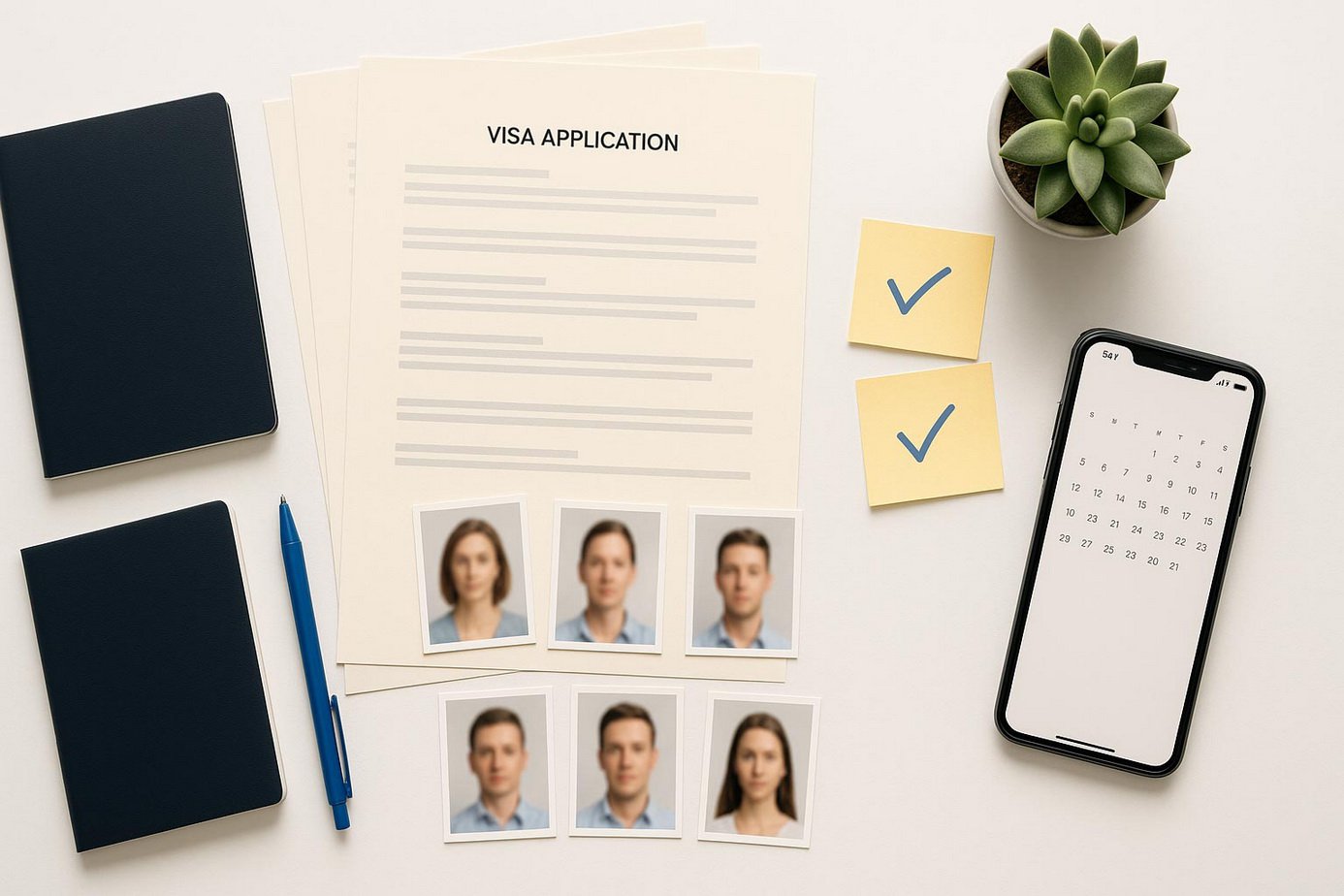
The long-term visa application process consists of several stages and requires careful document preparation.
Application Instructions:
- Determine the visa type and prepare your passport (valid for at least 4 months beyond your stay).
- Complete the visa application form.
- Take biometric photographs meeting Turkish specifications.
- Obtain a criminal background check with an apostille from your home country.
- Arrange health insurance covering your intended stay period.
- Prepare specific documents: for work visa — employment contract and Ministry of Labor permit; for student visa — acceptance letter and educational documents; for family visa — relationship documents and sponsor’s status.
- Complete the electronic application on the official website and upload document scans.
- Pay the consular fee.
- Schedule an appointment at a Turkish Consulate or Embassy.
- Submit original documents at the consulate and provide biometric data (fingerprints and photo).
- Wait for application review (up to one month).
- Collect the issued visa from the consulate and verify all information is correct.
- Enter Turkey with the issued visa.
- Apply for residence permit at the Provincial Directorate of Migration Management.
- Receive your ikamet card.
The most common mistake when submitting documents is inadequate preparation of translations and apostilles. All foreign-language documents must be translated by a sworn translator and apostilled. This includes diplomas, criminal record certificates, marriage certificates, and birth certificates.
Turkish Visa Requirements for Children
Children follow the same visa rules as adults, but the documentation process has specific requirements.
Documents for Minors:
- Child’s passport or entry in parent’s passport (regulations vary by nationality).
- Birth certificate (apostilled and translated).
- Parental consent for travel (if applicable by nationality).
- Health insurance.
- Photographs.
Important Considerations:
- Age requirements for separate passports vary by nationality (generally 14–18 years).
- For children traveling with one parent, consent requirements vary by citizenship.
- For long-term visas, notarized parental consent is typically mandatory.
- Fines for overstaying apply to minors but are paid by parents/guardians.
- Entry bans are rarely imposed on children.
Cost of Turkish Visas and Associated Expenses
Expenses for obtaining a Turkish visa and residence permit vary by document type and application method.
Service Type | Cost |
Consular fee | $60–120 (duration-dependent) |
Residence permit card (ikamet) issuance | 810 TL |
Health insurance | $200–500 annually |
Notarization of documents | Variable by country |
Translation services | Variable by country |
Document apostille | Variable by country |
Additional Expenses:
- Visa center service fees (if using an intermediary).
- Medical examinations and tests.
- Document courier/shipping.
- Biometric photographs.
Fees are subject to change. Always verify current rates on the official Turkish Ministry of Foreign Affairs website or at visa centers.
Total estimated costs for residence permit application per adult can range from several hundred to several thousand dollars, including all mandatory fees and services.
Penalties for Visa Violations (Overstay)
Exceeding your permitted stay in Turkey is a serious violation resulting in financial and administrative consequences.
Overstay Fines
The minimum overstay fine in Turkey is approximately 130 TL, provided the overstay doesn’t exceed 10 days. Maximum fines are uncapped, determined individually based on overstay duration and nationality.
Fine Structure by Nationality:
- Most nationalities: Varies by country agreements.
- Card issuance fee: Added if overstay exceeds 10 days.
Entry Bans (Deportation)
Prolonged visa violations result in entry bans to Turkey:
Violation Duration | Consequences |
Up to 3 months | Fine only, no ban |
3–6 months | Fine + 1-month entry ban |
6–12 months | Fine + 3-month entry ban |
1–2 years | Fine + 1-year entry ban |
2–3 years | Fine + 2-year entry ban |
Over 3 years | Fine + 5-year entry ban |
Fines must be paid upon re-entry to Turkey, even years after the violation. Refusing to pay does not eliminate the entry ban.
According to Article 54 of the Immigration Law, decisions on visa cancellation or entry bans are made for overstays exceeding ten days.
Turkish Consulates and Embassies Worldwide

For long-term visa applications, applicants can contact Turkish diplomatic missions in their country of residence.
Major Turkish Diplomatic Missions:
Embassy in Washington, DC (United States)
- Address: 2525 Massachusetts Avenue NW, Washington, DC 20008.
- Phone: +1 (202) 612-6700.
- Email: [email protected].
Turkish Consulates in the United States:
- New York, Los Angeles, Chicago, Houston, Boston, Miami.
Embassy in London (United Kingdom)
- Address: 43 Belgrave Square, London SW1X 8PA.
- Phone: +44 20 7393 0202.
Embassy in Ottawa (Canada)
- Address: 197 Wurtemburg Street, Ottawa, ON K1N 8L9.
- Phone: +1 (613) 789-4044.
For short-term visas and some document services, many countries have authorized visa application centers. Check the Turkish Ministry of Foreign Affairs website for locations.
Turkey Visa Requirements for Various Nationalities
Entry requirements vary significantly by citizenship. Here’s current information for major countries:
Country/Region | Visa-Free Period | Notes |
United States | 90 days per 180-day period | Most common for tourism/business |
European Union | 90 days per 180-day period | Most EU citizens |
United Kingdom | 90 days per 180-day period | Post-Brexit arrangement |
Canada | 90 days per 180-day period | Standard visa exemption |
Australia | e-Visa required | 90 days per 180-day period with e-Visa |
China | 30 days | Can be extended |
India | e-Visa required | Various durations available |
Brazil | 90 days per 180-day period | Visa exemption |
Japan | 90 days per 180-day period | Visa exemption |
South Korea | 90 days per 180-day period | Visa exemption |
GCC Countries | Varies 30–90 days | Depends on specific country |
Russia | 60 days (max 90 per 180 days) | Special bilateral agreement |
For long-term visas and residence permits, citizens of all countries follow similar procedures, with variations in document requirements based on home country regulations.
Frequently Asked Questions
It depends on your nationality. US, Canadian, UK, and most EU citizens don’t need a visa for tourism or short business visits up to 90 days within a 180-day period. Australian and some other nationals must obtain an e-Visa online before travel. Check the official Turkish e-Visa website for your specific requirements.
Most visa-exempt nationalities can stay up to 90 days within any 180-day period. Some countries have different limits (e.g., 30 or 60 days). The 180-day period is calculated on a rolling basis, not calendar periods.
You cannot extend visa-free entry. For legal stays beyond the permitted duration, you must apply for a residence permit (ikamet) before your authorized period expires. After submitting the application, you can legally remain until a decision is made.
A visa run involves exiting Turkey to reset your stay period. Popular destinations include Georgia (visa-free for many nationalities), Northern Cyprus, and Bulgaria. However, since 2023, Turkish authorities scrutinize visa runs more strictly, and this method may result in entry denial, especially if you’ve exhausted your 90-day limit.
The Turkish employer initiates the process by applying to the Ministry of Labor for a work permit. After approval, you apply for a work visa at a Turkish Embassy/Consulate in your country. You cannot obtain a work permit as a tourist without an employer sponsor.
Yes, if you hold a valid residence permit for at least 6 months. Your employer applies to the Ministry of Labor, and the transition occurs without leaving Turkey. Tourists on visa-free entry cannot convert to work status without departing first.
A visa is entry permission stamped or placed in your passport, obtained before travel. An ikamet is a plastic residence permit card that allows extended stays in Turkey. Visas are obtained at consulates abroad; ikamets are issued by immigration authorities inside Turkey.
No. Tourist residence permits explicitly prohibit employment. To work legally, you must obtain a work permit and corresponding residence permit. Unauthorized employment leads to fines, deportation, and entry bans.
Your passport must be valid for at least 60 days beyond your planned stay or visa expiration, whichever is longer. For example, if entering visa-free for a potential 90-day stay, your passport should be valid for at least 150 days from entry.
Health insurance is not mandatory for visa-free tourist entries, but strongly recommended. However, obtaining any type of residence permit requires Turkish health insurance coverage for the entire permit period as a mandatory requirement.
We will send you a content digest not more than once a week