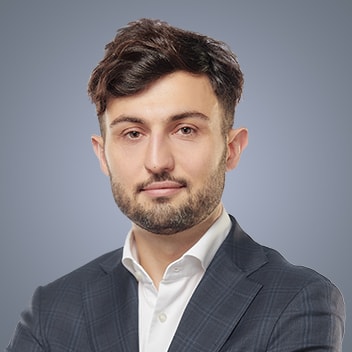
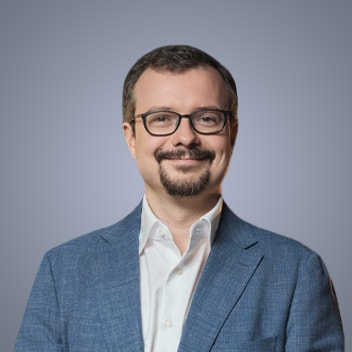
George Kachmazov

George Kachmazov

Founder

We will help you thoroughly research the market so that you can make a confident and informed decision
Request consultation
  • About the expert
  • Articles 9
  • Quotes 54

Founder of Tranio, Managing Partner of Tranio Capital

With over 20 years of experience in international real estate and investment, Georgiy oversees projects across Europe, the Middle East, and the Mediterranean. Since founding Tranio in 2010, he has led the company to complete more than 2,500 transactions worth around €500 million and build a partner network spanning 70 countries. In 2022, he shifted his focus to development investments and established Tranio Capital.

Date of birth: March 5, 1985, Moscow

Career

  • 2007–2010 — Managing Partner at internet marketing company Optimism.ru.

  • 2010 — Founded and became CEO of Tranio, an international real estate brokerage.

  • 2016 — Closed the company’s first development deal in Barcelona.

  • 2017 — Launched projects in Germany and Greece with a total pipeline exceeding €150 million.

  • 2022 — Focused fully on development investments, delegating the brokerage arm to co-founder Mikhail Bulanov. Established Tranio Capital, dedicated to early-stage development projects.

  • 2023 — Entered the UAE market, partnering with leading developers on early-stage mixed-use projects totaling over 380,000 sq m.

  • 2024 — Expanded to Cyprus with three office and residential projects totaling 15,000 sq m.

  • 2025 — Preparing to launch the company’s first Silver Living project in Greece.

Education

Kutafin Moscow State Law University (2006), degree in Jurisprudence.

Expertise

Georgiy’s professional expertise covers the full cycle of development projects, from site selection to investment exit. Within Tranio Capital, he is personally involved in all key processes:

  • Asset selection — identifying early-stage projects and sites with strong growth potential.

  • Market analysis and forecasting — leading Tranio Capital’s research hub to inform strategic decisions in Europe, the Middle East, and Asia.

  • Developer partnerships — negotiating terms of cooperation and joint financing.

  • Financial structuring — designing deal frameworks, co-investment models, and exit strategies.

  • Risk and quality control — assessing projects for liquidity, partner reliability, and demand sustainability.

This combination of skills makes him an expert in residential, commercial, and hospitality real estate, as well as new formats including senior living.

Thought Leadership

  • Regular speaker at international real estate and investment conferences.

  • Contributor and commentator for leading media outlets such as Bloomberg, Forbes, The Times, RBC, and Kommersant.

Personal

  • Active athlete, twice a finisher of the Ironman triathlon.

  • Supports educational initiatives and programs for young professionals.

Greece is currently one of the few undervalued markets in Europe with strong potential for property investment. George Kachmazov, CEO and founder of Tranio, explains why Greece is an attractive choice.

Tranio.com explores the new trend dominating the German real estate market.

2020 was a tough pill to swallow for Europe’s real estate markets as some segments were forced into extremely disruptive lockdowns and others were given development incentives.

The knock-on effects of the coronavirus – widespread panic, quarantine, falling oil prices, and weakening oil-dependent currencies like the Russian ruble – are hitting the real estate market hard.

Many of our clients at Tranio are individuals with budgets starting from €100,000, who want to invest in property abroad. While skimming the market, it may seem like this amount is not enough to buy a decent income-generating property in Europe in locations where quality commercial spaces go for no less than €5 million, while small retail facilities can fetch anywhere between €3-5 million.

The volume of commercial property transactions concluded in 2017 has amounted to $698b. According to JLL, transactions volume of the global real estate market for the first three quarters of 2018 increased 7% year-on-year to $507b.

Tranio managing partner George Kachmazov discusses how the portrait of a Russian-speaking foreign real estate investor has changed over the past eight years.

Tranio has been working with overseas real estate for more than eight years. Over the past three years, the company has been focussed on development projects, primarily in Germany. Good investment projects are not easy to find in the central European country: there are not enough projects to meet investment demand, and local professional developers can afford to be picky with whom they choose to work.

Investors often ask for our help in finding a 10–30 rooms hotel managed by an established operator under a long-term contract abroad. However, they do not plan on relocating and participating in the management of the hotel but want to receive a guaranteed income.

Based on all these factors, I consider Greece to be one of the most promising European destinations for investment, and Athens to be the most attractive location in the country. Since 2017, our company has been carrying out development and renovation projects in Greece, as well as assisting with other processes: obtaining residence permits and managing properties.

Source: «Invest in Greece Real Estate in 2026», 09 June 2025

When staying in Athens on business, I like to dine in the city centre at two restaurants: Ατίταμος (I think it is pronounced as «atítamos») and Mani Mani. These restaurants are not too expensive, but they serve delicious traditional Greek cuisine.

And although they are not too close to Monastiraki (but rather to the south of the Acropolis and the historical hills), they are close to the municipal offices with which we often have to interact and perhaps you, too, if you are engaged in obtaining a residence permit or real estate in Greece.

Source: «Where to stay in Athens», 03 Apr. 2023

As the outflow of foreign buyers in 2020–2021 was primarily connected with the COVID-19 restrictions, cross-border activities by buyers might be expected not just to bounce back but also to exceed the pre-pandemic level as the restrictions are lifted — the pent-up demand will revive the market.

Source: «Transnational real estate investment: 2021 year-end results of Tranio’s survey», 30 June 2022

During the COVID-19 pandemic, many found it difficult to adapt to the mandatory travel restrictions, so investors showed more interest in the programmes and products allowing for freer international travel.

Source: «Transnational real estate investment: 2021 year-end results of Tranio’s survey», 30 June 2022

I believe the online transaction trend is here to stay for the long term. Many investors acquired investing know-how to choose counterparties and make major investment decisions and will be keeping up this business acumen after the COVID-19 pandemic.

Source: «Transnational real estate investment: 2021 year-end results of Tranio’s survey», 30 June 2022

Over the ten years that Tranio have been conducting market expert surveys, cross-border investors have gained more experience and developed stronger acumen.

Many of our clients already understand the rules of the investing game in the target market where they buy property, keep their yield expectations realistic, get surrounded by a team of advisors, and are on equal footing with local investors as a result. It was a rare case just a decade ago.

Source: «Transnational real estate investment: 2021 year-end results of Tranio’s survey», 30 June 2022

Many investors structure capital "entry" into German companies through founder loans with the assistance of qualified tax advisors, which helps to decrease the tax base significantly.

In practice, this reduces the tax burden on rental income almost to zero in the first 10–15 years of investment.

Source: «Property tax in Germany», 04 March 2021

I think that Malta is on the list due to its popular ‘golden passports.’ The demand for other countries is explained by a combination of historical interest, the quality of location, low taxes for non-residents, the availability of inexpensive Russian-speaking consultants, and convenient logistics.”

A total of 32% of respondents say that the UK is losing its popularity as a jurisdiction for changing tax residency faster than any other country. This decline is not only linked to Brexit, but also to changes in tax legislation, which is forcing foreigners permanently to pay tax on income received outside of the country.

For example, many foreigners who permanently resided in the UK were previously exempt from paying tax on income earned outside of the country, and since 2017 there have been fewer reasons for exemption from these taxes.

Source: «Overseas financial activity of Russian HWNIs — a Tranio and EY joint survey, 2019», 01 May 2020

In 2018, the Federal Tax Service of Russia received the first data on the foreign bank accounts of Russian tax residents. I don’t think the tax authorities have enough resources to process all the information they’ve received, however, as the skills, practices, and instruments of automation of Russia’s tax authorities improve, they will gradually use this data more effectively in order to increase the volume of tax collected from Russians’ foreign incomes.

Naturally, Russia’s tax authorities will primarily be interested in cases involving larger amounts of money, but eventually they will also focus on less high profile cases.

The steady rise of the number of Russians reporting both foreign accounts and CFCs can be explained by the fact that more HNWIs understand that if they want to remain a tax resident of Russia, they need to notify the authorities. There’s only one legal alternative: stay in Russia for no longer than 183 days a year and cease to be a tax resident.
Source: «Overseas financial activity of Russian HWNIs — a Tranio and EY joint survey, 2019», 01 May 2020

Foreign banks, including those in the Baltic states, are tightening compliance and now handle money from Russia incredibly carefully in line with anti-money laundering procedures. 

Even if someone tries to deposit money that was earned legally and provides all the necessary documents to prove its origin, the banks will examine them top to bottom to observe strict protocols.

Foreign banks are looking for any reason to reject applications for loans or deposits – they are protecting themselves from possible sanctions by regulators.

Source: «Overseas financial activity of Russian HWNIs — a Tranio and EY joint survey, 2019», 01 May 2020