Transport in Turkey in 2026

Despite Turkey being a large country, travelling around it is relatively easy as the country’s transport system is very well developed. Tourists and citizens have access to:
- affordable flights between cities;
- an easy-to-understand public transport system in major cities;
- high-speed railways;
- ferries;
- intercity bus services;
- straightforward car rental schemes.
This infrastructure allows tourists with any budget to explore easily even the most remote corners of the country. In our review, we’ll discuss the main types of transport in Turkey, provide links to official company websites and ticket booking resources — everything that will help you begin your journey without problems and without unnecessary overpayments to intermediaries.
Public transport in Turkey
The easiest way to immerse yourself in the country’s culture and feel like a local is to start actively using public transport. Moreover, tourist cities such as Istanbul, Antalya, Alanya, have a clear scheme of urban and intercity communication that is easy to understand, even without knowing the language.
Buses in Turkey
Buses (Otobüs) are the most common type of intercity transport in Turkey. Each region has its own network of intercity buses belonging to various carrier companies.
It’s usually about half the price of a flight but takes much longer: the average speed of bus travel across the country is about 60–80 km/h. For example, a bus ride from Istanbul to Antalya will cost between 4 and 24 US dollars and will take 10–13 hours.
In most cases, the quality of service is roughly the same. The cabin has a toilet, air conditioning, TV, free WiFi, and a phone charging socket. It’s clean inside, relatively spacious and comfortable, with free water provided, and sometimes snacks and sandwiches are included in the price. With some operators, you can ask for a blanket and pillow during an overnight journey. There are scheduled stops along the way where you can stretch your legs, buy food, and smoke.
Buses depart from large terminals (Otogar). Within a small area, there are dozens of different companies competing with each other, surrounded by numerous eateries and souvenir shops.
To purchase tickets, there are English-language resources with schedules, prices, and useful tips for travellers. Tickets can be purchased on the day of travel directly at the bus station or via the Internet. On popular routes, buses depart every 1–2 hours.
Minibuses in Turkey
Dolmuş is a small collective bus that operates in cities and rural areas. It travels between two points along a precisely defined route and at fixed time intervals. Passengers can get on and off wherever they wish. Simply signal to a dolmuş from the roadside, and it will stop to pick you up.
In Turkish, the word «dolmuş» means «full». The name comes from the fact that the dolmuş doesn’t depart until it has a sufficient number of passengers.
For example, in Antalya, there are about 70 different routes served by dolmuş. It’s estimated that there are about 1800 «stops» on these routes. If you’re in a dolmuş and want to get off, you need to shout «Inecek var», which means «someone wants to get off». The driver will stop at the first opportunity.
Dolmuş also operates between cities. For instance, from Antalya, you can reach Akseki, Aksu, Alanya, Finike, Kaş, Kemer, Manavgat, Beldibi, Belek, and other places by minibus.
Dolmuş stations can be found at bus terminals. The schedule is sometimes written on small stands, occasionally by hand with a marker.
Prices for each route are fixed. Payment is made in cash, which is passed from passengers to the driver. To the right of the driver, next to the gear stick, there is a small box in which he puts change in the appropriate compartments. This allows him to give change even during the journey. Tickets for Dolmuş are not issued.
Metro in Turkey
The metro system is implemented in Istanbul, Bursa, Adana, and Ankara. Istanbul also has a light rail system called Istanbul LRT.
A system of high-speed urban commuter trains exists in Izmir (Izban), the suburbs of Istanbul (Marmaray) and Gaziantep.
Metro maps are available both as applications and are duplicated at each station. Stops are announced in Turkish, in advance, so it’s difficult to miss your station. Generally, there are no problems with using the metro.
For those considering purchasing property in Istanbul, it’s worth studying the map of stations of the Marmaray commuter train. The proximity of housing to its stations significantly affects the cost per square metre.
Metrobuses
This is a system of rapid buses in Istanbul, which allows traffic-free travel over long distances between the European and Asian sides. There are 8 routes across the city in total. They start with the number 34, run at intervals of 1 to 8 minutes even at night and are mainly used by local residents as they connect residential areas with each other.
Trams
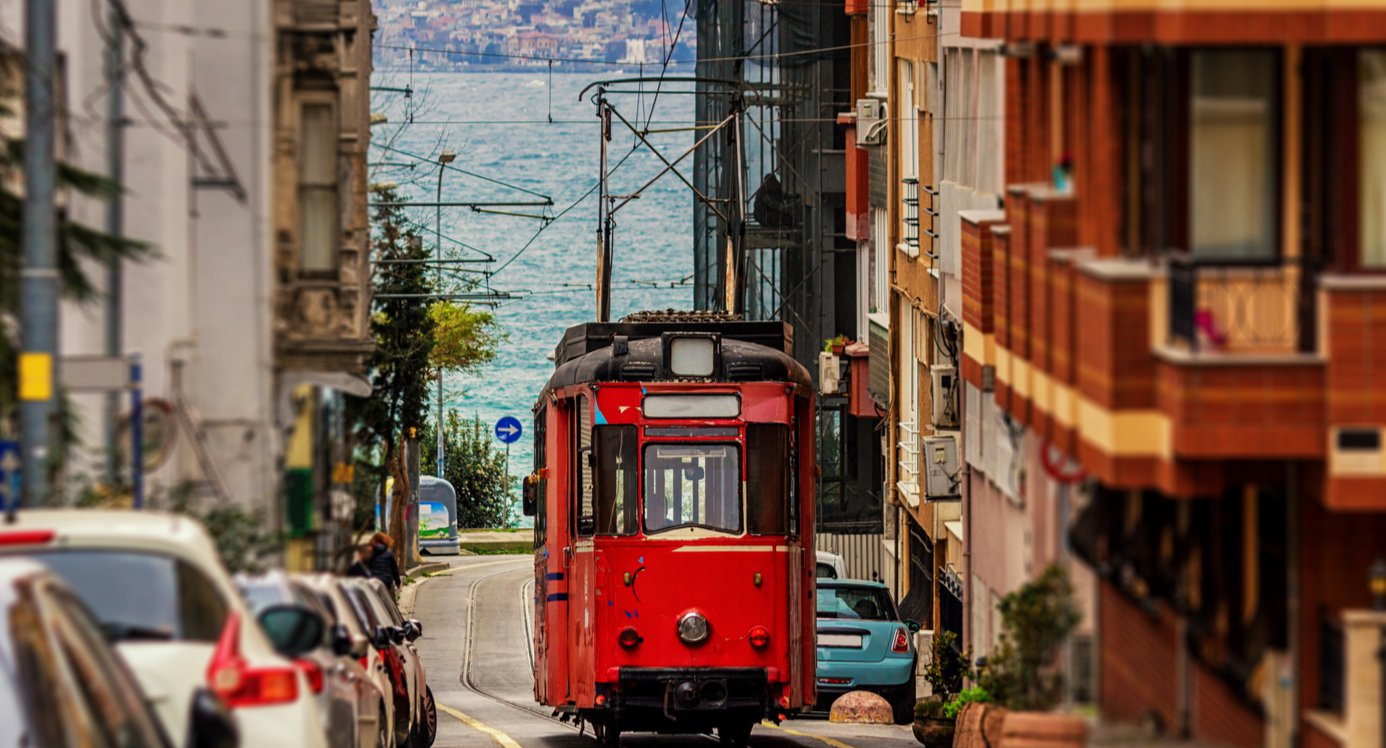
Low speed, scenic routes through the main tourist attractions, and vintage carriages make trams a very popular means of transport around the city for tourists. The T1 route in Istanbul, which passes through tourist locations on the European side of the city, is particularly popular.
The 11-kilometre tram line in Antalya is also frequently used by tourists as it connects the airport, the historic part of the city, and the largest city beach. Modern trams operate on non-tourist city routes, but even retro carriages are often now equipped with air conditioning.
Trains
Despite numerous alternatives in the form of local airlines and bus services, some travellers prefer the romance of trains. For them, the Turkish railway administration offers high-speed mainlines and regular ones. There are 3 types of carriages: sleeping compartments, open-plan sleepers, and seating.
In terms of cost, ticket prices are comparable to buses. For example, a trip to Ankara from Istanbul will cost 11 US dollars and take 4.5 hours. Trains are chosen when an overnight journey is planned and there’s an opportunity to save on hotel costs. Also, the train + bus combination allows comfortable travel to Pamukkale and Cappadocia.
A major disadvantage of trains in Turkey is that the railway is not laid to the most popular tourist resorts on the Mediterranean and Black Sea. The nearest Mediterranean resort that can be reached by rail is Izmir.
There are also tourist named routes (Blue Train, Aegean Express, etc.). One such route is the «Eastern Express». Unlike the famous train from the early 20th century, which connected Istanbul with Paris, the modern train runs from Ankara to the city of Kars in the east of the country. Locals love this route for its picturesque snowy landscapes, which they consider a winter fairy tale with an eastern flavour.
Features of Turkish taxis
No time to figure out public transport systems? Then your choice is a taxi. The problem is that in tourist cities, taxi drivers can be crafty, trying to «rip off» tourists for the maximum fare with minimal effort.
Taxi prices in Turkey are calculated by meters that assess kilometres and minutes. So it’s advisable to know in advance how far you’re going before getting into a taxi. You’ll need to pay any road tolls if your taxi journey includes travel on a highway or bridge that charges a fee.
Drivers are generally very sociable; they often try to chat with you in English. If you need help, drivers ask for assistance from colleagues or relatives who know foreign languages.
How to order a taxi?
- Via app. If you’re in a major tourist city like Istanbul, Ankara or Bodrum, you can order a taxi through an app, such as Uber, or its equivalent — BiTaxi (links for Android / iOS). Locals also use KiwiTaxi and Istanbul’s BiTaksi.
- By phone. In smaller Turkish cities such as Eskişehir, Bilecik, Nevşehir or Artvin, to call a taxi, you need to call the numbers or ask the hotel administrator to do so.
- Press the taxi call button on the street.
- Wave to a passing car with the word Taxi on it.
Of course, the first two options are the safest. Using apps will also help you avoid fraud by drivers.
Travel cost
Prices for travel differ in different cities. The cost is calculated: boarding price + price per kilometre × number of kilometres on the meter + waiting price × waiting time. In some regions, there is a minimum trip cost: 20–50 lira. However, many taxi drivers immediately quote their price for the trip and try to negotiate.
The main cost guideline for a trip is the taximeter. There is a standard rate for all taxi drivers in the city. The Uber rate usually matches the taximeter, but individual taxi drivers may charge more, especially in central tourist areas.
You can try to agree in advance on the Uber rate, it’s the cheapest. But it doesn’t account for additional costs for passing through toll bridges and tunnels. The boarding cost is usually 13 lira, the price per kilometre ranges from 3.7 to 5.5 lira.
Turkish taxi drivers’ tricks
What do taxi drivers do to get more money from the customer?
Long route
Drivers choose a longer route with the maximum number of traffic jams.
What to do in this case? Know the approximate route in advance. Protest immediately if the taxi driver deviates from it.
Manipulations with the meter
Some tricksters don’t reset it after the previous passenger — then you’ll pay for two trips at once. Or they say the meter isn’t working and offer to agree on a fixed payment.
The taxi meter should be located on the rear-view mirror on the lower side; make sure it’s turned on and zeroed.
What to do? Immediately find the meter when getting into the car, make sure there’s no extraneous data on it. If the meter shows something strange, refuse to travel. The taxi driver has no right to work on a route with a broken meter.
Payment from each passenger and for luggage
This is also a violation; payment is required for the entire vehicle, regardless of how many passengers or items are present.
Write down the number of your taxi in Turkey, so you can report violations to the company if something goes wrong.
Car rental in Turkey (car-sharing)
If you’re staying in Turkey for an extended period, want to see as much as possible in a short time or have more freedom of movement, then car rental will be the best option.
Do you need an international driving licence to rent a car? The answer to this question depends on the period for which you plan to rent a car. You can read more about this in our article about driving licences in Turkey.
Most roads, even of regional importance, have good road surfaces and are safe to drive on.
To be given a car in car-sharing systems, you need to have at least one year of driving experience and be over 18 years old. If you meet all the parameters, then you need to register in the app and link a bank card to it.
Major car-sharing operators in the country are:
- Yoyo — this company has parking lots at all major airports in the country, in cities along the coasts of the Marmara and Black Seas. You can rent a car through a mobile app, cars can only be returned to company parking lots. The fleet includes Renault, Citroen, Ford, Mercedes, Volkswagen, Audi, and even electric cars, all equipped with access to Spotify. Daily rental costs start from 159 lira.
- ZipCarTurkey — works only within Istanbul and is available to people over 21 years old with at least 1 year of driving experience. There are two tariffs: Flex, where you can leave the car anywhere, and Trip, where the car must be returned to a special parking lot, otherwise, there’s a fine of 500 lira.
How much will it cost? The price of car sharing in Turkey starts from 60 Turkish lira for boarding, the cost of AI-95 petrol is 7 lira per litre, diesel fuel is 6.5 lira. The rest depends on the class of the car and the rental period.
Car rental
Besides car sharing, there are many companies that rent out cars. You can find them through aggregators, for example Turkeycar or Turkeyrentalcar. Rental services are also easy to find in resort towns. sea transport
Aggregators calculate the rental cost in a currency convenient for you and offer several car model options.
In resort towns, there are chats for visitors where it’s easy to arrange joint rental of transport for trips to attractions.
Sea transport in Turkey
Perhaps the most attractive type of transport in Turkey, a country situated between four seas, is the ferry or ship. You can travel to local seaside resorts or abroad, feeling the breeze, accompanied by seagulls and dolphins.
International ferries on the Black Sea connect Turkey with Russia, Bulgaria, Romania, and Ukraine. In the Mediterranean Sea, ferries connect Greece, Cyprus, Lebanon, and the Italian islands.
Call the port one or two days before the start of the tour to find out if the time or date of departure has changed. Unfortunately, this is not rare.
It’s advisable to arrive at the port 1.5–2 hours before departure, as you’ll have to go through passport control and customs (like at airports). Don’t forget to bring your passport and other necessary documents and familiarise yourself with Turkey’s customs regulations.
Turkish port cities
Black Sea | Aegean Sea | Marmara Sea | Mediterranean Sea |
Hopa İnebolu Samsun Trabzon Zonguldak | Izmir İnebolu Samsun Trabzon Zonguldak | Gemlik Bandırma Istanbul İzmit Derince | İskenderun Mersin Antalya |
Urban water transport
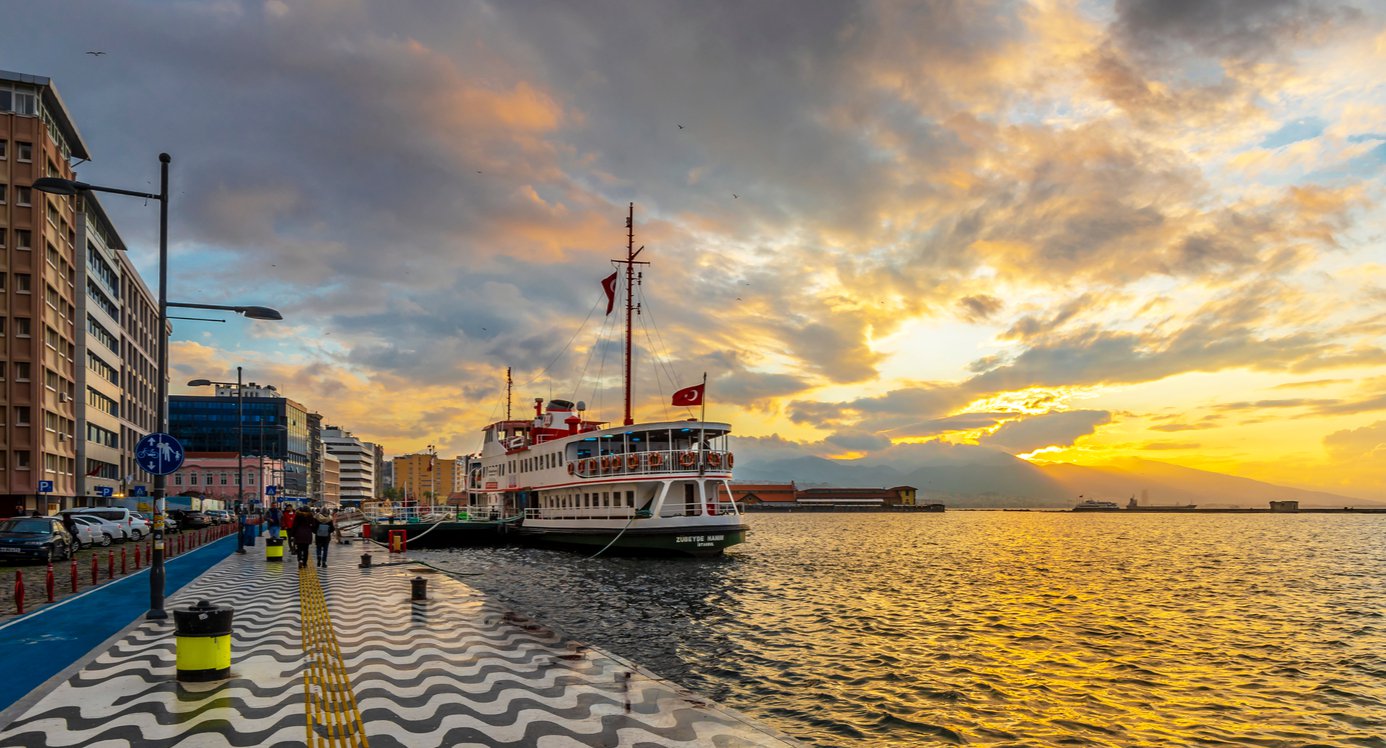
Ferries are a popular form of internal transport in Istanbul: vessels run between the metropolis’s ports, allowing you to avoid traffic jams on bridges. Such trips can be paid for with regular transport tokens.
There are three major passenger ports in Istanbul: Kabataş Ferry, Yenikapı, and Kadıköy. Domestic flights between Turkish cities from here are performed by companies İDO and BUDO.
IDO routes allow you to easily get from Istanbul to cities such as Yalova, Bursa, Bandırma or İznik. For example, if you want to get from Yenikapı port on the European side of Istanbul to Bursa by ferry, you can find a ticket for about 160 Turkish lira and up.
BUDO transports to Bursa and Armutlu. Ticket prices start from 110 Turkish lira.
Çanakkale ferries serve one of the most beautiful cities in Turkey. The ferry schedule along the Dardanelles Strait is compiled by the company GESTAS. Ferries depart almost every hour, tickets can be purchased online.
The most popular ferry routes across the Dardanelles are: Çanakkale — Eceabat, Gallipoli — Lapseki, Çanakkale — Kilitbahir, Geyikli — Bozcaada, Kabatepe — Gökçeada. The cost of the Çanakkale — Eceabat journey: 10 Turkish lira for each passenger, 135 lira for each car.
Air connections
Planes are the most convenient, fastest and most expensive way to travel around Turkey. Turkish airlines operate regular flights to various points throughout the country. Ticket prices average about 20–30 US dollars for a one-way flight. Tickets can be purchased online, from an airline agent or through an authorised tour operator.
Air travel is now the standard in this large country, and it makes sense for people with limited time or for those who want to visit remote places such as Van or Erzurum.
Turkish Airlines has the most extensive route network, as most flights from the west are operated via Istanbul or Ankara.
The local low-cost airline Pegasus Airlines is based at Sabiha Gökçen Airport (Istanbul), from where it operates inexpensive flights throughout the country and beyond.
Airline carrier SunExpress has an extensive network of transportation both within Turkey and to countries in Asia and Europe.
Cycling
Have you planned a cycling route through the country? This is a feasible task, however, you need to understand that the risks of repair and maintenance of the two-wheeled vehicle will have to be taken on yourself, as there are few specialists in bicycles, and they are concentrated in large cities such as Ankara, Antalya, Istanbul and Izmir.
A new bicycle can be purchased in Turkey, or brought with you. Bicycle rental points are available in tourist locations, for example, in Cappadocia, especially Göreme, Antalya, Istanbul.
Rental of scooters and mopeds
The boom in individual electric transport has not bypassed Turkey: in resort towns, you can ride with the wind in your hair on scooters and mopeds with and without seats. These vehicles are easy to rent right on the spot, using a website or applications, among which the most popular are: Marti and Binbin. To use them, you need to have a phone, a Turkish SIM card, and the ability to top up the application balance.
We will send you a content digest not more than once a week