Mortgage in Cyprus for foreigners in 2026



Cyprus remains a highly attractive destination for investors focused on the European real estate market, thanks to its unique blend of stability, strategic geographic position, and favourable entry conditions.
With its Mediterranean climate, flexible tax residency regime, and the opportunity to secure permanent residency through property acquisition, the island offers a compelling proposition for both residential living and long-term investment.
The mortgage market in Cyprus is structured in line with best practices across leading European markets. Local banks extend financing to both residents and foreign buyers, with average interest rates around 4% per annum, providing investors with an efficient means to leverage capital for property acquisition.
This article provides an overview of the key features of Cyprus’ mortgage landscape: the banking institutions available to foreign investors, the requirements for borrowers, and critical considerations when structuring an optimal deal.
Submit a request and receive expert advice from Tranio on selecting property in Cyprus and choosing the most profitable investment options.
Submit a request
Mortgage Financing in Cyprus: Key Aspects
The dominant product in the market is euro-denominated loans with a floating interest rate, linked to the European Central Bank’s base rate plus a bank margin. Fixed rates are available, but are not widely popular.
The average mortgage term is approximately 22 years.
Regulation and Legislation
Cyprus’ mortgage market operates within a clearly structured regulatory environment, with the cornerstone being the Immovable Property Transfer and Mortgage Law No. 9/65.
This law sets the fundamental principles for regulating mortgage transactions and defines the requirements for market participants, ensuring transparency and predictability in procedures.
Role of the Central Bank of Cyprus
The Central Bank of Cyprus (CBC) is the key regulatory authority in the mortgage sector, responsible for setting lending limits and managing core risks. Currently, Loan-to-Value (LTV) ratios are capped at 80% for primary residences and 70% for other property types, helping maintain a balanced risk profile for banks. The CBC also publishes market indicators: as of February 2025, the average mortgage rate is 4.56% per annum.
Additionally, debt sustainability is monitored through the Debt-to-Income (DTI) ratio, which is set within a range of 30–40% in 2025. This approach helps mitigate the risk of loan defaults, contributing to the overall stability of the banking system.
Regulatory Framework and Requirements
Under Law No. 9/65, all mortgage transactions in Cyprus must be registered with the Department of Land and Survey (DLS). Failure to register the transaction renders it legally invalid.
If a borrower defaults on payments for more than 120 days, the lender is entitled to initiate enforcement procedures and sell the mortgaged property via public auction. During the first three months, the minimum sale price is set at 80% of the market value, which drops to 50% in the following three months. Borrowers have the right to contest the sale notice in court within 45 days, and if a court injunction is granted, the process can be suspended.
Additional safeguards are in place for borrowers involved in government subsidy programmes. Since January 2024, a provision allows for the suspension of foreclosure proceedings on primary residences for those applying to the «Mortgage-to-Rent» scheme, designed to support individuals facing financial difficulties.
Mortgage Application Process in Cyprus

Cypriot banks have established a comprehensive set of criteria to ensure transparency and the effective management of credit portfolios.
Borrower Requirements
For non-EU citizens, the key requirements for getting a mortgage are possession of a residence permit, permanent residency in Cyprus, and approval from the Council of Ministers to purchase property.
For EU citizens, proof of a stable income source and documentation confirming registration of residency in Cyprus is required to get a mortgage.
Foreign buyers are typically required to provide a down payment ranging from 20% to 50% of the property’s value, depending on the bank's policies and the borrower’s risk profile.
For Cyprus residents and EU citizens, the minimum down payment is generally lower, ranging from 10% to 30%.
Applicants must be at least 18 years old at the time of application and no older than 65 years at the time of loan repayment. Some banks may extend the maximum age to 70, though this could involve higher interest rates or additional collateral requirements.
Mortgage repayments should not exceed 30–35% of the borrower’s total income to ensure manageable debt levels and reduce the risk of default.
Creditworthiness Assessment
Banks in Cyprus assess borrowers’ creditworthiness based on several criteria and required documents:
- Income statements, bank account statements, tax returns, and documentation verifying employment or self-employment.
- A minimum credit score of 650 is required, and self-employed individuals must provide audited financial statements.
- Existing loans must not impair the ability to service new debt.
Documents Required for a Mortgage Loan Application
- Passport or residence permit.
- Bank statements (for the past 3–6 months).
- Sales agreement and proof of property ownership.
- Proof of the down payment.
- Property valuation report.
- Approval from the Council of Ministers (for non-EU buyers).
Choosing a Mortgage Lender
Cyprus Banks’ Mortgage Offers in April 2025:
Bank | Rate Type | Rate Range |
Bank of Cyprus | Variable | 4.95–5.50% |
Hellenic Bank | Fixed | 3.5–4.28% |
Alpha Bank | Variable | from 4.28% |
Ancoria Bank | Variable | from 3.45% |
AstroBank | Variable | from 4.9% |
Property Valuation Process
To establish a uniform base for real estate taxation, the Council of Ministers of Cyprus mandates general property valuations. These valuations are solely for tax purposes and are not used in property transactions, investment or collateral assessments, or compulsory acquisition procedures.
The update of real estate data is a comprehensive process, involving on-site inspections, satellite imagery, geographic information systems, and an integrated land registry database.
Valuation is based on an analysis of market transactions, construction costs, and other relevant indicators applicable to the year of assessment. Key factors considered include the individual characteristics of land plots (size, accessibility, shape) and buildings (area, age, category, technical condition). Mass valuation is conducted using specialised software and includes a mandatory quality control stage to verify final values.
The results of the overall valuation are available to property owners through the official website of the Department of Lands and Surveys, via phone (17100 for local calls, +35722804900 for international calls), and through local authorities.
Should any discrepancies be found in property characteristics (such as area, construction date, or zoning), owners have the right to submit an electronic application for correction, free of charge, within one year of the publication of results.
 From 205,000 €
Completion in: 2027.II Total of 105 apartments
 From 520,000 €
Built in 2022 64 units in total
 From 800,000 €
Built in 2025 67 units in total
 From 320,000 €
Completion in: 2028.IV Total of 88 apartments
 From 845,000 €
Completion in: 2027.I Total of 330 apartments
 From 545,000 €
Completion in: 2026.IV Total of 24 apartments
 From 510,000 €
Completion in: 2026.IV Total of 44 apartments

Mortgage Terms and Rates in Cyprus
In July 2026, the average interest rate on loans for house purchase in Cyprus was 3.78% per annum.
Typical Mortgage Conditions
In 2025, mortgages remain accessible to both Cypriot citizens and foreign buyers. However, the borrower’s profile plays a critical role in determining loan terms.
Borrower Category | Maximum LTV (%) |
Residents (Primary Property) | 80% |
Foreign Buyers | 60–70% |
Secondary Properties/Investment | 70% |
Loan Details:
- Loan term: 10 to 35–40 years.
- Minimum loan amount: €75,000.
- Repayment limit: Not exceeding 33% of the borrower’s monthly income.
- Fixed and variable interest rates available.
Fixed-Rate and Floating-Rate Mortgages
Fixed-rate mortgages are typically offered for short periods of 3, 5, or 10 years, with some banks providing long-term fixed rates for up to 25 years. After the fixed period expires, loans usually convert to a variable rate.
Floating-rate mortgages are based on key market indicators:
- European Central Bank (ECB) base rate.
- Central Bank of Cyprus base rate.
The floating rates, including bank margins, range from 4.60% to 5.50% annually, depending on the borrower’s down payment, profile, and selected conditions.
Floating rates offer potential benefits in the event of future base rate reductions, but they also expose borrowers to the risk of higher payments if there are adverse changes in the ECB’s monetary policy.
Additional Fees and Costs
Below is a summary table of the primary fees associated with mortgage lending for individuals, according to the official provisions of the Bank of Cyprus Commissions and Charges — Physical Persons, 04/2025:
Fee Type | Amount/Rate |
Documentation Fees | €50 (loan amount up to €20,000) |
€75 (loan amount above €20,000) | |
Early Repayment (Mortgage Cancellation) | €75 |
Cancellation of Unexecuted Loan | 0.50% of the amount (maximum €1,000) |
Fee for Unutilised Loan Balance | 1.5% per quarter (on unused loan balance) |
Mortgage for Foreign Nationals

EU and EEA citizens have the right to get a mortgage without the need for permanent residency. However, mortgage conditions are generally less favourable compared to Cyprus residents and citizens: higher down payments, stricter income verification requirements, and a lower maximum loan-to-value (LTV) ratio (up to 70%).
Non-EU citizens are required to obtain Cypriot residency to access mortgage programmes, as well as obtain approval from the Council of Ministers for property acquisition.
The approval process typically takes between one week and two months.
Age and Income Requirements
To qualify for a mortgage in Cyprus, borrowers must be under 65–70 years old at the time the loan term expires. Banks also require proof of stable income.
Banks typically ask for tax returns, bank statements for the past 3–6 months, and proof of employment or self-employment. The minimum income level must ensure that monthly payments do not exceed 33% of the borrower’s total income.
Down Payment and Interest Rates
For non-residents, the down payment ranges from 30% to 50% of the property value. For EU citizens and Cyprus residents, the down payment ranges from 10% to 30% (specific terms depend on the bank and borrower profile).
In July 2026, the average interest rate on loans for house purchase in Cyprus was 3.78%; individual offers vary with the property, down payment and borrower profile.
Required Documents
The basic document package includes:
- Passport.
- Residence permit (for non-residents).
- Sales agreement.
- Property title deed.
- Proof of income.
- Bank statement.
- Council of Ministers approval (for non-EU citizens).
All documents must be translated into Greek or English and notarised.
Processing time varies from 2 weeks to 2 months.
Advantages and Risks of Mortgage Lending in Cyprus
As of 2025, the Cypriot mortgage market offers a fertile ground for strategic decision-making, blending opportunities with a measured approach to risk management. This is a space where one can not only capitalise on competitive rates and government support but also test strategies in a rapidly growing economy and real estate market.
Cyprus’ economy continues its upward trajectory, with an anticipated GDP growth of 3.2% in 2025, driven by domestic demand and tourism. This growth lays a solid foundation for trust among banks and investors, with lenders more inclined to work with collateral and borrowers benefiting from greater flexibility in servicing debt.
Advantages of Mortgage Lending
Government support schemes, such as the updated housing assistance programme offering grants of €20,000—€50,000 for first-time buyers, lower the entry barriers.
At the start of 2025, banks also eased mortgage approval requirements for the first time since 2009, reflecting an improved risk perception and increased competition among financial institutions.
For lenders, the rising demand for residential properties (27 out of the 50 largest transactions in 2025 are residential) ensures liquidity of collateral. Borrowers, in turn, benefit from the European Central Bank’s reduced rates, leading to a decrease in average mortgage interest rates and lowering monthly payments.
Risks and Limitations
Mortgages linked to the ECB’s base rate remain vulnerable to volatility: a 0.5% rate shift could result in significant increases in monthly payments.
Lenders are increasingly rejecting applications for mortgages on secondary properties without title deeds, complicating property purchases on the secondary market. Issues with unfinished projects or legal disputes raise the risks of loan rejection.
Trends in Mortgage Lending in Cyprus
The second half of 2024 saw notable changes in the Cypriot mortgage market. Banks eased conditions on new home loans, affecting both standard and higher-risk mortgage products. The main drivers of this shift were lower interest rates and reduced bank margins on new loans, directly linked to increased competition and a change in risk perception within the banking sector.
This marks the first real easing of conditions since 2015, reflecting an improved macroeconomic environment and a positive risk outlook for the mortgage segment. Increased competition among banks also played a key role, with lenders actively vying for clients by offering more flexible terms and lowering entry barriers for new borrowers.
Market Dynamics
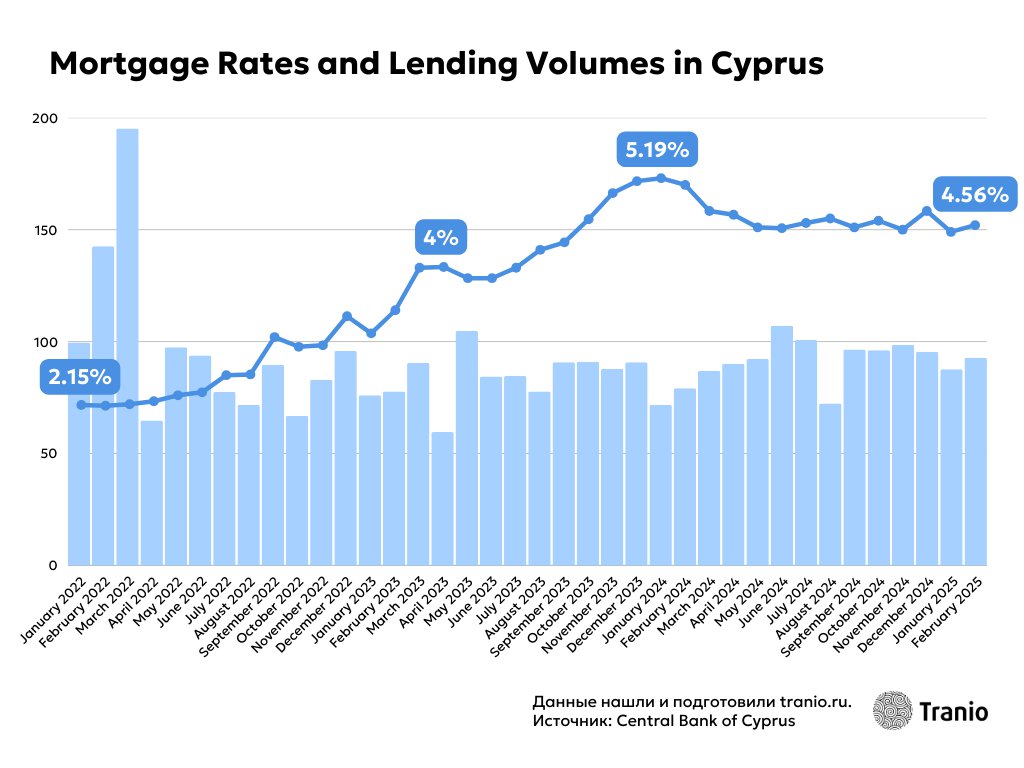
As of February 2025, mortgage lending volumes remained stable, despite expectations of increased demand reflected in banking surveys conducted in the autumn of 2024.
The net demand for housing loans among households in Q4 2024 remained unchanged, which contrasts with bank forecasts that anticipated market revival. Key factors influencing consumer demand have not undergone significant changes.
Mortgage Market Expectations — Central Bank of Cyprus Survey, Q4 2024:
Category | Q4 2024 | Q1 2025 (Expectations) |
Credit standards for loans | Unchanged | Eased |
Overall lending conditions | Eased | — |
Demand for loans | Unchanged | Increase |
FAQ
Foreign nationals can obtain a mortgage in Cyprus, provided that non-EU citizens must hold a residence permit, establish permanent residence on the island, and obtain special permission from the Council of Ministers to purchase property. EU citizens must demonstrate stable income and registration at their place of residence.
For foreigners, the standard down payment is 20–50% of the property value, with banks typically requiring 30–50% for non-residents. For EU citizens and Cyprus residents, the minimum down payment is lower, typically 10–30%.
A foreign citizen must first obtain a residence permit in Cyprus and obtain approval from the Council of Ministers to purchase property. After selecting a property and agreeing to the terms of the deal, they must gather the necessary documents (passport, residence permit, proof of income, bank statements, purchase agreement, and approval from the Council of Ministers), submit an application to the bank, and await approval. Once approved, the down payment is made and the transaction is finalised.
The process includes selecting the property, obtaining preliminary mortgage approval from a bank, gathering the necessary documents (passport, proof of income, bank statements, purchase agreement, etc.), making the down payment, and registering the transaction with the Department of Lands and Surveys. Subsequently, the mortgage agreement is signed, and loan funds are transferred to the seller.
The average mortgage rate in Cyprus in April 2025 is between 4.17% and 4.56% per annum. For new properties, rates can start from 3.28%, while for secondary properties, they can reach up to 7.5%.
Required documents include income certificates, bank statements for the past 3–6 months, tax returns, and documents confirming employment or self-employment. Self-employed individuals must provide audited financial statements. All documents must be translated into Greek or English and notarised.
Obtaining a mortgage in Cyprus is relatively straightforward for foreigners with a residence permit. The requirements include obtaining approval from the Council of Ministers, making a down payment (30–50%), and providing proof of income and creditworthiness. Banks are actively working with foreign buyers, and with all required documents and sufficient income, obtaining a mortgage is achievable.
🏠 Only for built properties
💼 Legal income required
🕒 Approval in a month
We will send you a content digest not more than once a week