Buying Property in Spain as a Foreigner in 2026


.webp)
According to the Colegio de Registradores, in 2024, the Spanish real estate market reached its historic maximum and exceeded record levels set in 2007. The increase in residential property prices relative to 2023 was 8.4%, according to the National Statistics Institute (INE).
Property prices are projected to continue to rise in 2025, albeit at a more moderate pace. A nominal growth rate of about 4% is expected, exceeding the inflation rate. However, there are risks of faster price growth, given the current boom in the real estate market and the general state of the Spanish economy.
Seven steps when registering a property in Spain
1. Get an Foreigner Identity Number (NIE)
NIE is a taxpayer’s number, which is necessary for conducting any financial and legal activity. You can’t buy a house without NIE.
You can get an NIE at the consulate of your country of residence or at the Spanish police station by appointment.
Required documents:
- EX-15 application form;
- notification of the reasons for submitting the application;
- the original and a copy of the passport;
- receipt of payment of the fee;
- photo.
2. Open a bank account
A Spanish bank account is needed to pay for the transaction, all related expenses, utilities, and taxes.
Required documents:
- passport;
- NIE;
- proof of income.
When depositing more than 10,000 euros in cash, you need to show a declaration. It is processed at customs upon entry into Spain. The declaration confirms the legality of the origin of the funds.
3. Select a property and sign a preliminary agreement with the seller
It is important to pay attention to the location, age of the housing, materials, quality of decoration, and quality of infrastructure. The property catalog will help you find the right price, location, and type of housing.
After selecting a property, the buyer contacts the seller to discuss the terms of the transaction. If both parties are satisfied with the terms, they enter into a preliminary agreement with a deposit. There are no requirements for the amount of collateral, but it is usually 10% of the value of the property. The contract specifies the deadline for final settlement and the legal conditions.
If the buyer changes his mind about purchasing the property after signing the preliminary agreement, the seller does not refund the deposit. If the seller cancels the transaction, he will refund the deposit in double the amount.
 1,433,000 €
Total area 133 m² 2 bedrooms
 1,299,000 €
Total area 101 m² 3 bedrooms
 1,309,000 €
Total area 78 m² 2 bedrooms
 1,839,000 €
Total area 163 m² 3 bedrooms
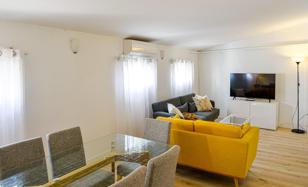 725,000 €
Total area 113 m² 3 bedrooms
 1,809,000 €
Total area 144 m² 3 bedrooms
 1,250,000 €
Total area 170 m² 3 bedrooms
 1,349,000 €
Total area 120 m² 2 bedrooms
4. Conduct a legal review of the property
It is necessary to check with the help of a Spanish lawyer: ownership, absence of debts and restrictions, building licenses, compliance with the real and legal status.
5. Sign the final agreement
The buyer and seller sign the purchase and sale agreement in the presence of a notary. The notary also certifies the document and provides copies.
The buyer transfers the remaining amount to the seller’s account and receives the original purchase agreement within three months after the transaction.
6. Register the property in the Property Registry
Registration will take about three months, after which the buyer receives an extract from the registry.
7. Pay taxes and fees
- VAT on the purchase of a new property is 10% for residential real estate, 21% for commercial;
- stamp duty — 0.5–2% of the cost of the property;
- notary services and the fee for registration of real estate in the Land Registry — 0.2–2% of the property price: the more expensive the property, the more profitable the rate;
- the commission of real estate agents is 3–5%;
- the transfer tax on the purchase of secondary housing is 6-11%, depending on the region.
Region | Rate, % | Region | Rate, % |
Alava | 6 | Cantabria | 8–10 |
Andalusia | 8–10 | Castile-La Mancha | 9 |
Aragon | 8–10 | Castile and Leon | 8 |
Asturias | 8–10 | Catalonia | 10–11 |
Balearic Islands | 8–11 | La Rioja | 7 |
Biscay | 6 | Madrid | 6 |
Valencia | 10 | Murcia | 8 |
Galicia | 10 | Navarre | 6 |
Gipuzkoa | 7 | Estremadura | 8–11 |
The Canary Islands | 6.5 |
What is important for a property buyer in Spain to do
- Open an account in a Spanish bank to transfer money to the seller, pay taxes and notary services.
- Apply for an NIE at the consulate or upon arrival in Spain.
- Select a property This can be done in the Tranio catalog.
- Sign a preliminary agreement with the seller and make a deposit.
- Apply for a mortgage, if necessary. To do this, you need to provide the bank with personal documents and a preliminary purchase and sale agreement.
- Sign the main purchase and sale agreement and pay the entire amount.
- Register real estate in the Property Registry.
The Tranio team will help you choose and purchase a property for any purpose.
Contact us
✅ Yes, there are no restrictions
📄 You need to get an NIE number
🏦 Spanish bank account is required
We will send you a content digest not more than once a week
- Property Prices
- Buying and Registering
- Mortgage
- Residence
- Citizenship (getting passport)
- Property Maintenance
- Education
- Taxes