Spanish residency in 2026



A residence permit in Spain opens up access to European medicine and education, makes it possible to travel through the Schengen area without a visa and live in a beautiful and safe country, and in the future — to obtain Spanish citizenship.
We tell you how to get a residence permit in Spain, on what terms and how much it costs. The article uses data from the Migration Portal of the Spanish Ministry of Migration.
Obtaining a Spanish residence permit
Currently the main ways to obtain a residence permit in Spain include the digital nomad visa, non-lucrative visa, employment or studies in Spain and family reunification.
General requirements for obtaining a Spanish residence permit
- be at least 18 years of age;
- possess medical insurance;
- possess a clean criminal record;
- not be banned from entering Spain;
- be neither an EU citizen nor a relative of an EU citizen;
- not suffering from any serious disease with potential consequences for themselves and the wider public;
- must be staying legally in Spain;
- have paid all data processing fees.
In some cases, it is necessary to meet additional requirements. Let’s consider them while analysing each type of residency:
Investment-based residency in Spain
Since 2013, Spain has operated a Golden Visa programme for investments in real estate and public funds. The residence permit was designed to stimulate the Spanish economy by attracting large foreign capital.
On January 3, 2025, due to the current situation in the Spanish real estate market and the unavailability of housing for Spanish citizens, the Spanish Congress of Deputies decided to cancel the possibility of obtaining a residence permit when investing in real estate this year. The law comes into force on April 3, 2025.
Permits issued before the programme was abolished remain valid until their expiry date. Renewal is possible under the transitional rules, provided that the applicant continues to meet the conditions of the status previously granted.
Residence permit of a digital nomad of Spain
In 2025, Spain continues to offer the digital nomad visa, which allows remote workers to legally reside and work in the country. The main requirements include a contract with a foreign company or freelancer status with foreign clients, work experience of at least three years or higher education, as well as a monthly income of at least €2,849 per month, or €34,188 per year. An additional 75% of the SMI is required for the first family member, and 25% of the SMI for each additional family member.. This amount is calculated based on the annually updated minimum income figures in Spain.
Non-Lucrative residence visa in Spain
This type of residence permit is issued to Non-Lucrative visa in Spain foreigners who have sufficient funds for a comfortable life in Spain. For 2026, according to data published on the Spanish state website, the main applicant must have at least 400% of the Spanish IPREM indicator, which is updated every year, which currently amounts to 2,400 euros per month, and family members — from 100% IPREM, or 600 euros per month for each. Some sources also recommend calculating the amount from 2,800 euros per month for the main applicant and from 700 euros per month for family members.
It is important that a foreigner must earn money outside of Spain and have proof of the legality of his earnings. Another necessary condition is that you must either have your own home or be able to rent it. After the first year of residence, this residence permit is extended two more times for 2 years.
A foreigner with a temporary residence permit without the right to work becomes a tax resident of Spain.
To obtain a Spanish residence permit without the right to work, you must meet all the requirements, have proven means of living and be interviewed at the consulate of your home country.
Documents for obtaining a resident’s card are submitted after arrival in Spain to the Office of Foreigners or to the provincial police station.
 1,433,000 €
Total area 133 m² 2 bedrooms
 1,299,000 €
Total area 101 m² 3 bedrooms
 1,309,000 €
Total area 78 m² 2 bedrooms
 1,839,000 €
Total area 163 m² 3 bedrooms
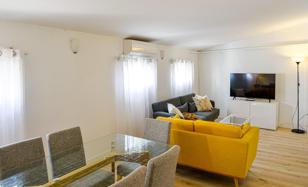 725,000 €
Total area 113 m² 3 bedrooms
 1,809,000 €
Total area 144 m² 3 bedrooms
 1,250,000 €
Total area 170 m² 3 bedrooms
 1,349,000 €
Total area 120 m² 2 bedrooms
Residence permit with the right to work
Residency with the right to work is granted to employees and self-employed workers. Temporary residence permits are also available for internships, scientific research, and seasonal work.
Requirements for employees. Spanish and EU citizens, and foreigners whose spouses or parents are legal residents of Spain, who are applying for jobs receive priority employment. Non-EU citizens without close relatives in Spain have two options:
- Apply for a job from a list of hard-to-fill positions, published quarterly by the Public Employment Service.
- Apply for a position previously rejected by a Spanish or EU citizen.
It is prohibited to seek employment upon entering the country unless already in possession of a work permits in Spain.
Requirement for self-employed workers. To obtain residency, applicants must prove they are qualified by providing either a university diploma or course completion certificate, depending on their occupation. For example, it is impossible to be a medical practitioner without a medical degree.
For employees: | For the self-employed: |
passport + copy | passport + copy |
two EX-03 applications | two EX-07 applications |
proof of professional qualification | proof of professional qualification |
signed labour agreement | viable project (with estimated investment and expected profits) |
proof of the company’s solvency | |
TIN + copy |
Steps to obtain. The residency application procedure is initiated by the employer, who contacts the local department of the Ministry of Labour and Migrations. Afterwards, the employer will receive the document and send it to the employee, who must then submit this document to a Spanish consulate in their home country. Self-employed workers must contact a consulate by themselves. The consulate will review the application and give a response within three months. Within a month after approval, the documents for the visa must be submitted by the applicant. Successful applicants must then enter Spain within three months after the visa has been issued, and residency must be applied for within 30 days of arrival.
Student residence permit
To study in Spain, a foreigner needs a short-term or long-term student visa. For short-term courses, a visa can be issued for up to 1 year, and for the entire period of study upon admission to the university.
To obtain a residence permit, a student must have an invitation to enroll from an educational institution, prove their financial viability, or have a government grant covering the necessary costs for their stay in Spain.
The financial requirement for students is the availability of capital for life: 100% IPREM + paid accommodation for the duration of your stay in the country.
Since 20 May 2025, new rules have applied to student permits in Spain:
- Only applicants over the age of 18 may apply for language courses, while applicants to Spanish universities must be over 17.
- It is still possible to apply for a residence permit for higher education in Spain from within the country if the applicant holds a Schengen visa or a residence permit from another EU country. However, a student visa for language courses can only be obtained through the consulate in the applicant’s country of residence.
- Students may work up to 30 hours per week, provided that the work is compatible with their study programme and the conditions of the specific permit are met.
- Students taking language courses can no longer include family members in their visa applications.
- A student residence permit based on language courses can be renewed only once.
Residence permit for family reunification
According to the law, an official spouse, partner, minor and dependent children under the age of 26, and parents over the age of 65 can obtain a residence permit.
Requirements. A resident can apply for residency for relatives after a year of living in Spain and obtaining a residence permit for at least a year. You will also have to prove that you have the means to live — 150% IPREM for two family members and 50% for each next one.
If a resident wants to obtain a residence permit for a partner, it is necessary to prove that the relationship began before he moved to Spain. It is not necessary to be in a registered relationship. A residence permit is required even for those who are not officially married: it is important to prove cohabitation, accounts and interests before moving to Spain.

Residence by settlement
Residence by settlement can be applied for by illegal immigrants who have resided in Spain for at least two or three years.
Since 20 May 2025, a new regulation has been in force: for several types of arraigo, the minimum period of residence has been reduced from three years to two.
Requirements for obtaining a residence permit in Spain:
- You must have an employment contract for a minimum of one year.
- You need to earn at least 100% of the IPREM (living wage). If you have a family, then you should earn 200%.
- You should not have left the country for more than 120 days.
- You must have close relatives in Spain, or be married to, or in a registered partnership with a Spanish citizen.
Those who are not employed in Spain need to prove that they have sufficient means to live in the country and provide a report from the mayor’s office on their successful integration into Spanish society.
Steps to obtain. The documents are submitted to the Office of Foreigners at the place of residence along with a receipt for payment of the fee. A residence permit with a work permit will be ready within three months. Then, documents for obtaining a foreigner’s identity card are submitted to the same department.
How to extend a residence permit
For an extension, a foreigner applies to the Bureau for Foreigners at the place of residence when there are less than 60 days left before the end of the current residence permit period. The decision on the extension will be ready within two months.
Starting in 2025, a new mechanism of «silent refusal» to extend a residence permit will be introduced. Residency may be considered indefinite if no response has been received from government authorities within 2 months from the date of the resident’s application.
Students will need to provide documents confirming their studies: for example, diplomas of an educational institution or the results of a language exam.
To extend a residence permit with the right to work or for permanent residence, it is necessary to provide a contract with the employer, extended for the specified period.
How to become a permanent resident or citizen
A permanent residence permit allows foreigners to work and live in the country on the same terms as Spanish citizens.
You can apply for permanent residence in Spain in the following cases:
- You have legally lived in Spain for five years with a residence permit and have not left the country for more than six months at a time or for 10 months for five years.
- You have lived in the EU for five years on a Blue Card, of which you have lived in Spain for the last two years.
- You were born in Spain and lived in Spain for at least three years before applying for permanent residence.
- You have made a significant contribution to the economic, scientific or cultural development of Spain.
- You are in Spain as a refugee and/or you are at risk of serious harm upon your return to your home country.
- An application for permanent residence is submitted to the Office for Foreigners. The fee is paid within 10 days after the submission.
The Spanish permanent residence card is issued for five years, then it can be extended.
Citizenship documents are submitted after 10 years of residence in the country. To obtain Spanish citizenship, you need to know Spanish and pass the Spanish history exam. In Spain, dual citizenship with most countries is prohibited. The exceptions are Portugal, Latin American countries, as well as Andorra, the Philippines and Equatorial Guinea.
The Tranio team will help you choose the right type of residence permit when buying property in Spain, as well as create an investment strategy based on your individual case.
Contact us
🌍 Visa-free Schengen travel
🏥 Access to healthcare and schools
⏳ Pathway to citizenship
.jpg)
.jpg)
.jpg)
We will send you a content digest not more than once a week